Posts

Debugger

Debugger The Debugger is a program that allows the user to test and debug the object file. The user can employ this program to perform the following functions. Make changes in the object code. Examine and modify the contents of memory. Set Breakpoints, execute a segment of the program and display register contents after the execution. Trace the execution of the specified segment of the program, and display the register and memory contents after the execution of each instruction. Disassemble a section of the program; i.e., convert the object code into the source code or mnemonics. REFERENCES R. S. Gaonkar, Microprocessor Architecture, Programming, and Applications with the 8085, Fifth Edition, Penram International Publishing (India) Private Limited. S Ghoshal, Microprocessor Based System Design, Macmillan India Limited, 1996 M. Mano, Digital Logic and Computer Design, Prentice – Hall India B. Ram - Fundamentals of Microprocessor and Microcontrollers “Microp...
System Bus

System Bus There are three types of buses : Address Buss: A unidirectional lines determine the size of memory addressable by the processor. Data Bus : A bi-directional lines indicate the size of the data transferred between the processor and memory or I/O device. Control Bus: consists of a set of control signals indicates the type of action taking place on the system bus. REFERENCES R. S. Gaonkar, Microprocessor Architecture, Programming, and Applications with the 8085, Fifth Edition, Penram International Publishing (India) Private Limited. S Ghoshal, Microprocessor Based System Design, Macmillan India Limited, 1996 M. Mano, Digital Logic and Computer Design, Prentice – Hall India B. Ram - Fundamentals of Microprocessor and Microcontrollers “Microprocessors: Principles and Applications” by A Pal “Microprocessors and Microcontrollers : Architecture, Programming and Interfacing Using 8085, 8086 and 8051” by Soumitra Kumar Mandal “Introduction to Micropro...

Flags Register:

Flags Register The ALU influences a number of flip flops called flags which store information related to the results of arithmetic and logical operations. Taken together this flags constitute a flag register. The Flag register is a  Special Purpose Register  and is completely different from the other registers in a microprocessor. Flag register is an 8-bit register accessible to the user through instruction. Each bit in the flag register has a specific function.The other 3 are left vacant and are in the future Intel versions. Therefore, 8085 has five flags - Sign flag, Zero flag, Auxillary carry flag, Parity flag and the Carry flag. Only 5 bits out of 8 bits are used as shown below:  D7 D6 D5 D4 D3 D2 D1 D0 S Z X AC X P X CY The three crossed bit are redundant bits and not used. They can be either ‘0’ or ‘1’ but normally they are forced to be zero. The o...

Evolution of Microprocessors

Image
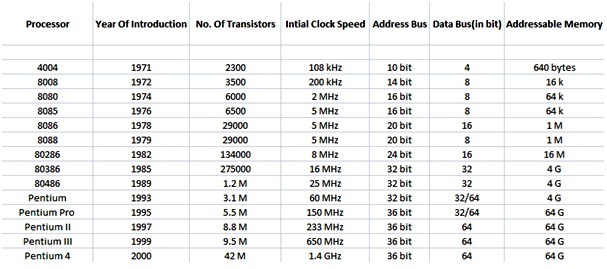
Table :- Intel Microprocessors Historical perspective The first Microprocessor (4004) was designed by Intel Corporation which was founded by Moore and Noyce in 1968. In the early years, Intel focused on developing semiconductor memories (DRAMs and EPROMs) for digital computers. In 1969, a Japanese Calculator manufacturer, Busicom approached Intel with a design for a small calculator which need 12 custom chips. Ted Hoff, an Intel Engineer thought that a general purpose logic device could replace the multiple components. This idea led to the development of the first so called microprocessor. So, Microprocessors started with a modest beginning of drivers for calculators. With developments in integration technology Intel was able to integrate the additional chips like 8224 clock generator and the 8228 system controller along with 8080 microprocessor with in a single chip and released the 8 bit microprocessor 8085 in the year 1976. The 8085 microprocessor consiste...

Assemblers & Assembler Directives

To assemble a program automatically the assembler needs information in the form of assembler directives that controls the assembly or Assembler directives are the directions to the assembler which indicate how an operand or section of the program is to be processed. These are also called pseudo operations which are not executable by the microprocessor. For example, the assembler must be told at what address to start assembling the program. These assembler directives are command placed in the program by the designer that provides information to the assembler. They do not become part of the final program as they are not the part of the instruction set of the microprocessor nor did they translate into executable code. Therefore, they are also known as pseudo-instruction on false instructions. Each assembler has its own unique pseudo instructions or assembler directives. These instructions differ from assembler to assembler but most of the assembler contains an equivalent set of pseu...